
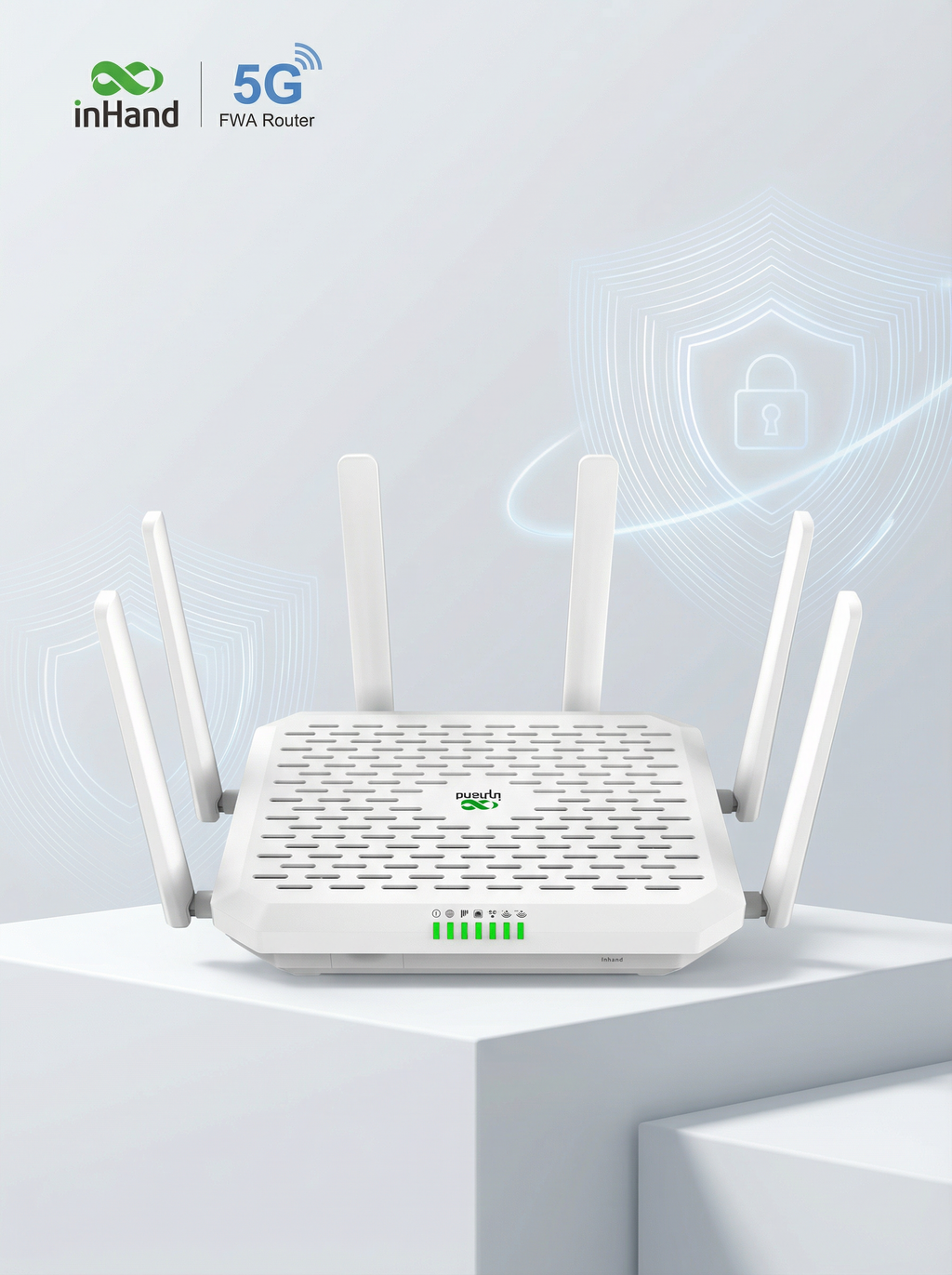
Enterprise branch offices and SMBs face a persistent connectivity dilemma: traditional wired connections are expensive and slow to deploy, while existing wireless solutions compromise on either speed, security, or management capabilities. The market has long needed a solution that delivers fiber-like performance, enterprise-grade security, and intelligent management—without the enterprise price tag or complexity.
Today, InHand Networks addresses this gap with the FWA12, the industry's first enterprise 5G router combining Wi-Fi 7 technology with AI-powered cloud management at a breakthrough price point of $499. This isn't just another incremental upgrade; it's a fundamental shift in what organizations can expect from branch office connectivity.
Table of Contents
- The Challenge: Why Current Solutions Fall Short
- Five Breakthrough Capabilities
- Technical Specifications
- FWA12 vs. Alternatives
- Real-World Use Cases
- Deployment and Configuration
- Pricing and Value Proposition
- Limitations and Best-Fit Scenarios
- Frequently Asked Questions
The Challenge: Why Current Solutions Fall Short
Before diving into what makes the FWA12 different, it's worth understanding why existing options leave IT teams frustrated.
Traditional fiber installations deliver excellent performance but come with significant drawbacks. Installation costs typically range from $3,000 to $10,000 per location, with lead times stretching 8-16 weeks. For organizations with multiple branch offices or those in rural areas, fiber simply isn't practical or available. Contract lock-ins and relocation costs add further inflexibility.
Existing 5G FWA routers offer wireless speed but typically pair 5G connectivity with outdated Wi-Fi 5 or Wi-Fi 6 technology, creating a bottleneck at the local network level. A 5 Gbps 5G connection becomes meaningless when your Wi-Fi can only deliver 1.2 Gbps to end devices. Additionally, most solutions lack integrated enterprise security features, requiring separate VPN gateways and firewall appliances.
Enterprise SD-WAN appliances from vendors like Cisco and Cradlepoint provide robust management and security but command premium pricing—typically $1,200 to $2,500 per unit—plus ongoing subscription fees of $150-300 monthly for cloud management platforms. For SMBs and multi-site enterprises, these costs quickly become prohibitive.
The FWA12 was designed specifically to eliminate these trade-offs.
What Makes FWA12 Different: Five Breakthrough Capabilities
1. Industry-Leading 5G Performance: 7.01 Gbps Downlink
The FWA12 leverages 5G Release 16 technology supporting both standalone (SA) and non-standalone (NSA) network architectures. With carrier aggregation (4 DL CA and 2 UL CA) and ultra-wide 300MHz bandwidth support, the device achieves peak downlink speeds of 7.01 Gbps and uplink speeds of 2.5 Gbps.
To put this in perspective: that's faster than most fiber connections deployed in branch offices today. A 7 Gbps connection can simultaneously support 140 HD video conference streams, or transfer a 10GB file in under 12 seconds. For bandwidth-intensive applications like cloud-based ERP systems, video surveillance, or large file transfers, this performance eliminates the traditional "branch office bottleneck."
The FWA12 also includes LTE Cat 19 fallback capability, ensuring connectivity even in areas where 5G coverage is still developing. This dual-mode operation provides deployment flexibility across diverse geographic locations.
Certifications: The FWA12 has received approval from major U.S. carriers including Verizon, T-Mobile, and AT&T, along with FCC, IC, and PTCRB certifications, ensuring broad compatibility and reliable performance across networks.
2. True Wi-Fi 7 Performance: 5000 Mbps with 128 Device Support
Here's where the FWA12 truly differentiates itself from competitors. While other 5G routers pair cutting-edge cellular technology with Wi-Fi 5 or Wi-Fi 6, the FWA12 is the first enterprise 5G router to integrate Wi-Fi 7 (802.11be) technology.
Technical advantages of Wi-Fi 7:
- 5000 Mbps maximum throughput (vs. 2400 Mbps for Wi-Fi 6)
- 320 MHz channel bandwidth (doubled from Wi-Fi 6's 160 MHz)
- 4096-QAM modulation (vs. 1024-QAM in Wi-Fi 6)
- Enhanced Multi-User MIMO for smoother simultaneous transmissions
- 128 concurrent device connections without performance degradation
In practical terms, this means a branch office with 50-80 employees can operate seamlessly with laptops, smartphones, tablets, VoIP phones, and IoT devices all connected simultaneously. Video conferences remain crystal clear, cloud application response times stay low, and large file uploads don't impact other users.
The dual-band configuration (2.4 GHz and 5.8 GHz) with three built-in Wi-Fi antennas ensures comprehensive coverage for typical office environments without requiring additional access points.
3. Enterprise-Grade Security Without Compromise
Security was not an afterthought in the FWA12's design—it's a core architectural component.
VPN Capabilities:
- IPSec VPN for site-to-site connectivity
- L2TP VPN for secure remote access
- Hardware-accelerated encryption ensuring VPN doesn't impact throughput
Advanced Firewall:
- Stateful firewall with 2 Gbps throughput
- Granular traffic management policies
- Application-level filtering and control
Security Monitoring:
- Real-time security logs
- Anomaly detection algorithms
- Email alert mechanisms for suspicious activity
- Integration with InCloud Manager for centralized security policy management
This integrated security architecture eliminates the need for separate firewall appliances or VPN concentrators, reducing both hardware costs and management complexity. For organizations subject to compliance requirements, the FWA12 provides the security foundation necessary for protecting sensitive data traversing wireless networks.
4. Network Resilience: Triple SIM with Intelligent Failover
Network downtime is unacceptable in modern business operations. A single hour of connectivity loss can cost enterprises thousands of dollars in lost productivity and revenue. The FWA12 addresses this with a sophisticated redundancy architecture.
Triple SIM Configuration:
- 2× Nano SIM card slots (hot-swappable)
- 1× eSIM with eUICC support
- Automatic carrier failover in under 3 seconds
- Load balancing across multiple carriers
This configuration provides several strategic advantages. Organizations can maintain SIM cards from different carriers, ensuring connectivity even if one carrier experiences network issues. The hot-swap capability means SIM cards can be replaced without powering down the device—critical for 24/7 operations.
For international organizations, the eSIM support simplifies deployment across different countries, eliminating the logistics of managing physical SIM cards for each location.
Additional resilience features:
- Built-in hardware and software watchdog for automatic recovery from system failures
- Self-healing capabilities that detect and resolve common connectivity issues
- Dual 2.5 Gbps Ethernet ports (WAN/LAN switchable) for wired failover scenarios
5. AI-Powered Cloud Management: InCloud Manager
Perhaps the most transformative aspect of the FWA12 is its integration with InCloud Manager, InHand's AI-powered cloud management platform. This is where the FWA12 moves beyond being just fast hardware to becoming an intelligent, self-optimizing network solution.
InCloud Manager capabilities:
Unified Management Dashboard:
- Manage unlimited FWA12 devices from a single pane of glass
- Real-time monitoring of network health, bandwidth utilization, and connected devices
- Customizable alerts and automated response workflows
Zero-Touch Provisioning:
- Pre-configure devices before shipping to remote locations
- Automatic configuration application upon first power-on
- Eliminates the need for on-site IT staff during deployment
AI-Powered Optimization:
- Machine learning algorithms analyze traffic patterns and automatically adjust QoS policies
- Predictive maintenance alerts identify potential issues before they impact operations
- Intelligent carrier selection based on real-time performance metrics
Centralized Security Management:
- Deploy security policies across all locations simultaneously
- Unified threat monitoring and response
- Compliance reporting and audit trails
For organizations managing multiple branch offices, InCloud Manager transforms network management from a time-consuming manual process into an automated, intelligent system. IT teams report reducing network management time by 60-70% after implementing InCloud Manager.
Complete Technical Specifications
| Category | Specification |
|---|---|
| 5G Cellular | 5G NR Release 16 (SA/NSA) 7.01 Gbps DL / 2.5 Gbps UL 4 DL CA, 2 UL CA 300MHz bandwidth support |
| LTE Fallback | LTE Cat 19 1.6 Gbps DL / 200 Mbps UL |
| Wi-Fi | Wi-Fi 7 (802.11be) 5000 Mbps max throughput 2.4 GHz + 5.8 GHz dual-band 128 concurrent devices 3× built-in antennas |
| SIM Support | 2× Nano SIM (hot-swappable) 1× eSIM (eUICC) |
| Ethernet | 2× 2.5 Gbps ports (WAN/LAN switchable) |
| VPN | IPSec, L2TP Hardware-accelerated encryption |
| Firewall | Stateful firewall (2 Gbps throughput) Application-level filtering |
| Management | InCloud Manager (cloud-based) Local web UI CLI access |
| Power | 12V DC, 3A PoE+ support (optional) |
| Operating Temp | -20°C to +60°C (-4°F to +140°F) |
| Certifications | FCC, IC, PTCRB Verizon, T-Mobile, AT&T approved |
| Dimensions | 240mm × 160mm × 45mm |
| Weight | 1.2 kg (2.6 lbs) |
FWA12 vs. Competing Solutions
| Feature | InHand FWA12 | Cisco Catalyst 8300 | Cradlepoint E3000 | Peplink MAX BR1 Pro 5G |
|---|---|---|---|---|
| 5G Speed | 7.01 Gbps DL | 5 Gbps DL | 5 Gbps DL | 4 Gbps DL |
| Wi-Fi Standard | Wi-Fi 7 | Wi-Fi 6 | Wi-Fi 6 | Wi-Fi 6 |
| Wi-Fi Speed | 5000 Mbps | 2400 Mbps | 1200 Mbps | 1200 Mbps |
| SIM Slots | 3 (2 Nano + 1 eSIM) | 2 Nano | 2 Nano | 2 Nano |
| Cloud Management | InCloud Manager (AI-powered) | Cisco DNA Center | NetCloud Manager | InControl 2 |
| Hardware Price | $499 | $2,500+ | $1,800+ | $1,299 |
| Monthly Mgmt Fee | Included (first year) | $200-300 | $150-250 | $99-199 |
| Target Market | SMB + Enterprise | Large Enterprise | Enterprise | SMB |
Key Insight: The FWA12 delivers superior wireless performance (both 5G and Wi-Fi)
Real-World Use Cases
Retail Chain Branch Connectivity
Challenge: A regional retail chain with 45 locations needed reliable connectivity for point-of-sale systems, inventory management, and video surveillance. Fiber wasn't available in rural locations, and existing DSL connections caused frequent transaction delays.
Solution: Deployed FWA12 units across all locations with dual-carrier SIM configuration for redundancy. InCloud Manager enabled centralized monitoring and policy management.
Results:
- 99.8% uptime across all locations (vs. 94% with previous DSL)
- Transaction processing time reduced by 65%
- Deployment completed in 3 weeks (vs. 6-month fiber installation estimate)
- Total cost savings: $180,000 annually compared to fiber alternative
Manufacturing Plant Temporary Connectivity
Challenge: A manufacturing company needed immediate connectivity for a new production line while waiting for fiber installation (estimated 12-week lead time). Downtime was costing $15,000 per day.
Solution: FWA12 deployed as temporary primary connection with plan to convert to backup once fiber arrived.
Results:
- Production line operational within 2 days
- 7 Gbps 5G performance exceeded the planned 1 Gbps fiber connection
- Company decided to keep FWA12 as primary connection and cancel fiber installation
- Saved $8,500 in fiber installation costs plus $120/month in recurring fees
Healthcare Clinic Network Expansion
Challenge: A healthcare network opening 8 new urgent care clinics needed HIPAA-compliant connectivity for electronic health records, telemedicine, and administrative systems.
Solution: FWA12 with IPSec VPN tunnels back to central data center, integrated firewall for security compliance.
Results:
- All 8 clinics operational within 10 days
- HIPAA compliance maintained through encrypted VPN tunnels
- Telemedicine video quality exceeded expectations (4K capable)
- IT team manages all locations from central dashboard
Deployment and Configuration
Out-of-Box Setup (On-Site)
-
Physical Installation (5 minutes)
- Mount device or place on desk
- Insert SIM card(s)
- Connect power adapter
- Device boots and auto-connects to cellular network
-
Initial Configuration (10 minutes)
- Connect laptop to default Wi-Fi network (credentials on device label)
- Access web UI at 192.168.1.1
- Run setup wizard: configure Wi-Fi SSID/password, admin credentials, time zone
- Apply settings and reconnect
-
Advanced Configuration (15-30 minutes, optional)
- Configure VPN tunnels to headquarters
- Set up firewall rules and traffic policies
- Configure carrier failover priorities
- Enable InCloud Manager integration
Zero-Touch Provisioning (Remote Deployment)
For organizations deploying multiple units:
- Pre-configure devices in InCloud Manager portal
- Ship devices directly to remote locations
- On-site staff simply powers on device and inserts SIM
- Device automatically downloads configuration and connects to network
- IT team verifies connectivity from central dashboard
Time savings: Reduces deployment time from 45 minutes to under 5 minutes per location. Eliminates need for on-site IT staff or remote support calls.
Pricing and Total Cost of Ownership
Hardware Pricing
- FWA12 Router: $499 (one-time)
- External Antenna Kit: $89 (optional, for challenging RF environments)
- Mounting Bracket: $29 (optional)
Software and Services
- InCloud Manager: Included free for first year, then $8/device/month
- Extended Warranty: $79/year (optional, extends warranty from 1 year to 3 years)
- Professional Services: Available for custom deployments (pricing varies)
3-Year TCO Comparison (Per Location)
| Cost Category | FWA12 | Fiber + Router | Cisco SD-WAN |
|---|---|---|---|
| Hardware | $499 | $800 | $2,500 |
| Installation | $0 (self-install) | $5,000 | $1,500 |
| Monthly Connectivity | $150 (5G unlimited) | $200 (fiber) | $150 (5G) |
| Management Platform | $8/mo (after year 1) | $0 | $250/mo |
| 3-Year Total | $5,991 | $13,000 | $22,400 |
ROI Analysis: For a 10-location deployment, choosing FWA12 over fiber saves $70,090 over 3 years. Compared to Cisco SD-WAN, savings reach $164,090—enough to fund additional locations or other IT initiatives.
Limitations and Best-Fit Scenarios
When FWA12 is Ideal
- Branch offices with 5-100 employees
- Locations where fiber is unavailable or cost-prohibitive
- Temporary sites or rapid deployment scenarios
- Backup connectivity for mission-critical locations
- Retail, healthcare, manufacturing, and field offices
- Areas with strong 5G coverage (check carrier coverage maps)
When to Consider Alternatives
- Extremely high bandwidth requirements: If you consistently need >5 Gbps sustained throughput (not peak), fiber may be more appropriate
- Poor 5G coverage: In areas without 5G coverage, consider LTE-only solutions or wait for 5G expansion
- Regulatory restrictions: Some industries or regions prohibit wireless for primary connectivity
- Very large enterprises: Organizations with >500 locations may benefit from enterprise SD-WAN platforms with more advanced features
Important Considerations
5G Coverage: Performance depends on local 5G network quality. Check carrier coverage maps and consider dual-carrier SIM strategy for redundancy.
Data Plans: Ensure your cellular plan supports high data usage. Most enterprise unlimited plans work well, but consumer plans may have deprioritization thresholds.
Antenna Placement: For optimal performance, place device near windows or in areas with strong signal. External antenna kit available for challenging environments.
Frequently Asked Questions
Q: Does the $499 price include InCloud Manager?
A: Yes, InCloud Manager is included free for the first year. After that, it's $8/device/month. Local management via web UI remains free forever.
Q: What cellular carriers does FWA12 support?
A: FWA12 is carrier-agnostic and certified for use on Verizon, T-Mobile, and AT&T networks in the U.S. It also supports international carriers with appropriate SIM cards.
Q: Can I use FWA12 as a backup to existing fiber connection?
A: Absolutely. The dual 2.5 Gbps Ethernet ports can be configured for automatic failover. If the primary WAN connection fails, FWA12 seamlessly switches to 5G within seconds.
Q: How many devices can connect simultaneously?
A: The Wi-Fi 7 radio supports up to 128 concurrent wireless devices. Wired devices connected via Ethernet don't count toward this limit.
Q: Is the device suitable for outdoor installation?
A: The FWA12 is rated for -20°C to +60°C operation but is not weatherproof. For outdoor deployment, use an appropriate weatherproof enclosure.
Q: What's the difference between FWA12 and consumer 5G routers?
A: Consumer routers lack enterprise features like VPN, advanced firewall, cloud management, triple SIM support, and carrier certifications. FWA12 is purpose-built for business use with appropriate security and management capabilities.
Q: Can I manage multiple FWA12 devices without InCloud Manager?
A: Yes, each device has a local web UI and CLI for individual management. However, InCloud Manager dramatically reduces management overhead for multi-site deployments.
Q: What happens if 5G coverage is unavailable?
A: FWA12 automatically falls back to LTE Cat 19, which still provides up to 1.6 Gbps downlink—faster than most business fiber connections.
Q: Does FWA12 support IPv6?
A: Yes, FWA12 fully supports IPv6 alongside IPv4 (dual-stack operation).
Q: What's the warranty and support policy?
A: FWA12 includes a 1-year hardware warranty. Extended 3-year warranty available for $79/year. Technical support available via email, phone, and online portal.
Conclusion: The Future of Branch Office Connectivity
The InHand FWA12 represents a fundamental shift in how organizations approach branch office connectivity. By combining 7.01 Gbps 5G performance, Wi-Fi 7 technology, enterprise-grade security, and AI-powered management at a breakthrough $499 price point, it eliminates the traditional trade-offs between performance, security, cost, and deployment speed.
For SMBs and cost-conscious enterprises, the FWA12 delivers 90% of enterprise SD-WAN functionality at 20-30% of the cost. For organizations in areas without fiber access, it provides performance that exceeds most wired alternatives. And for IT teams managing multiple locations, InCloud Manager transforms network management from a time-consuming burden into an automated, intelligent process.
The question isn't whether wireless connectivity can replace fiber—the FWA12 proves it already has. The question is whether your organization is ready to embrace the flexibility, cost savings, and performance that 5G-powered connectivity enables.
Ready to transform your branch office connectivity? Visit inhandgo.com/products/fwa12 to learn more or request a demo unit for your environment.


